All of the large farms in Albemarle County in this era, including those around Hollymead, relied on slave labor. Any history that does not include those individuals would be incomplete and misleading. However researching the lives of enslaved persons can be difficult because most references to slaves come only from legal records, and then generally only include first names.
There is an unusually large amount of information available about the enslaved persons who lived and worked at Woodburn. This article compiles all of those records to tell their story.
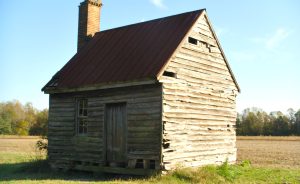
This slave cabin at Chippokes Plantation State Park is the second oldest such building in the commonwealth. Similar types of structures may have existed at Woodburn.
The 1860 Slave Schedule shows there were 16 slaves living on Woodburn farm. Eight were women and 8 were men, ranging in age from 6 months to 32 years old. The names of several of these individuals are contained in the African-American Families Database.
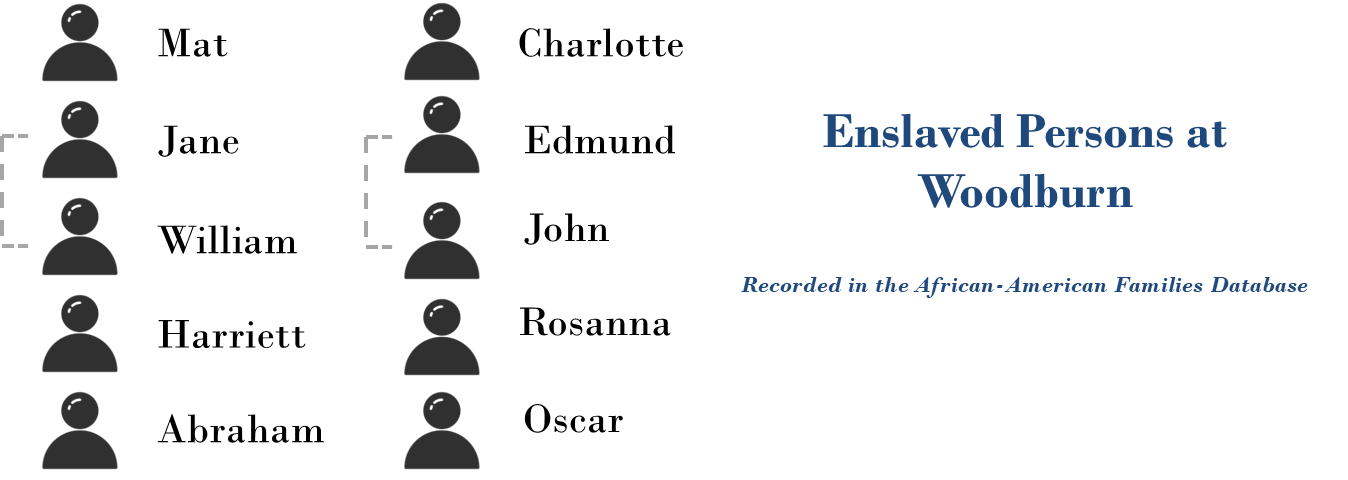
It appears that Edmund and John may have been brothers, and that Jane was likely the mother of William.
Death records at the Library of Virginia show that in 1862 Wood reported the death of a 21 year old slave named Wilson, who succumbed from typhoid pneumonia.
A court case brought by Wood’s widow, Martha, sheds light on the life of a slave named Mat, who worked on Woodburn as a blacksmith. Most large farms in this era had blacksmith abilities, and the estate sale held after Wood’s death in 1865 included blacksmith tools.
In 1863 Wood rented Mat for $325 to work in the shop of H.T. Bowles and George Dickinson. Martha brought a legal complaint in 1869, over four years after emancipation, claiming that Bowles and Dickinson never made their promised payment to Wood.

“On the first day of January Eighteen hundred and sixty four We promise to pay to A.C. Wood three hundred and twenty five dollars, hire for negro mail Mat to work at the blacksmith’s business during the year 1863. We further bind ourselves to give him the usual Summer and Winter clothing including a hat and a blanket. Given under our hands and seals this 6th day of January 1863.” – H.T. Bowles, Geo. C. Dickinson
The lives of several slaves owned by A.C. Wood are chronicled in the interactive website “Bleak House”, by Alice Cannon of CVHR. Ms. Cannon uses a variety of financial, legal, and census records to reconstruct their life stories from bondage to post-emancipation. The following vignettes are based on her research.
Hunter Bibb was owned by James B. Rogers, father-in law to A.C. Wood, and given to Wood when the child turned eight years old. This was the age when a slave child was expected to be able to provide enough labor to offset the cost of providing for him. Wood also had a child named Hunter, who was four years older, and it is tempting to think Hunter Bibb may have been a companion slave to Hunter Wood. Bibb’s mother was dead by the 1870 census where he is recorded as living in the household of Edmund Murray. A.C. Wood also owned a slave named Edmund, and this may be the same man. Following this census Hunter Bibb disappears from Albemarle County records.
Ellen was given to the Wood family in 1847 when she was eight years old. In 1861 A.C. Wood’s slave Ellen gave birth to a son named Oscar. She died the next year. Following emancipation, a child named Oscar (a distinctive name for Albemarle County in this era) of the correct age is listed as living in a household with several older emancipated slaves. This may be Ellen’s child Oscar, living in freedom with his extended family.
Allen and Judy Reed were slaves owned by James B. Rogers. Three of their children were given to Rogers’ children, including a son Henry who was owned by Wood and his wife Martha Rogers. After emancipation, the 1870 census indicates the Reed family was reunited and living together. Henry, now an adult, is listed as a cook. In 1874 he married and lived in Richmond for a time. By the 1880 census he is listed as a painter. By the 1900 census he had two children and was living in Washington D.C. where he was listed as a plasterer.